
EEAI case study: Emama Nguda Aboriginal Corporation – The Boab Street Program
Derby, Western Australia
Emama Nguda Aboriginal Corporation apply a culturally grounded approach and wrap around support to First Nations young people to re-engage with school
Overview
Community led and culturally appropriate approaches are essential for providing learning support and pathways that lead to better education outcomes for First Nations young people. The Education Engagement and Attainment Initiatives (EEAI) has been developed with community leadership and inclusion at the centre. The EEAI is an Australian Government program that provides funding to local organisations in locations across Australia, to support First Nations young people to improve their engagement and learning outcomes.
Emama Nguda Aboriginal Corporation approach
The Boab Street Program is a collaborative initiative between Emama Nguda Aboriginal Corporation (ENAC) and the Derby District High School (DDHS). The program is designed to address chronic school absenteeism among First Nations students, attending school less than 25 per cent of the time. Through a culturally grounded alternative classroom model, the program supports a staged re-entry into mainstream schooling. The initiative began with 22 students from five households, ranging from Years 4 to 12.
Shared responsibilities include joint planning, regular liaison, and coordinated student support.
Program design and implementation
Core elements of the program include:
- Employment of First Nations staff with strong community ties.
- Whole-family engagement strategies.
- Cultural learning as a foundation for identity.
- Individualised learning plans and multi-age classroom models.
- Safe, trauma-informed environments.
Students begin at the Boab Street facility, then gradually reintegrate into mainstream schooling while continuing cultural learning and support.
Holistic, culturally appropriate engagement and support
ENAC provides cultural grounding, family engagement, facilities, transport, and wraparound support. They demonstrate good leadership through role models, provide support with behavioural management and norm setting, and work with students to support the transition back to school.
DDHS offers educational infrastructure, flexible classroom models, and shares data to support targeted approaches. DDHS received the 2024 Best Practice Award for its work with students.
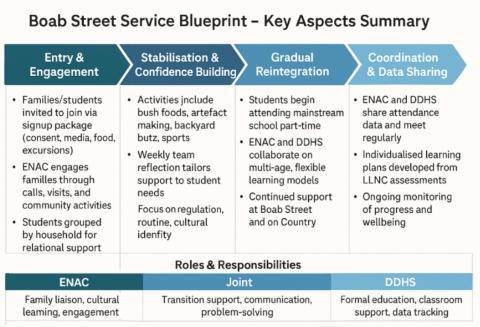
Figure: Brief summary of Boab Street Model Service Blueprint
Lessons learned and enablers of success include the importance of building trust and valuing relationships with external stakeholders as a foundation for successful engagement. Flexible delivery models have proven essential in meeting the diverse needs of students, while cultural safety and trauma-informed practices underpin positive outcomes.
Strong backend systems—such as reliable transport, provision of meals, and access to uniforms—ensure operational stability and support participation. Finally, regular reflective practice among staff strengthens program effectiveness and drives continuous improvement.
Through tailored on‑Country learning, whole family engagement, cultural identity development, and individualised reintegration plans, students have experienced increased self-regulation, confidence, strengthened cultural pride, and a renewed sense of hope and aspiration. These outcomes have been reflected in improved behaviour, new friendships, and enhanced wellbeing, alongside growth in cultural knowledge and skills, from hunting and fishing to artefact making, that reinforce identity and community belonging.
Conclusion
The Boab Street model has achieved major measurable outcomes, with participating students showing dramatic improvements in school attendance and educational attainment. The first cohort increased attendance from as little as 3 per cent (with many not having attended school more than a few times in years), to a sustained 78 per cent in 2023, including one student completing Year 12 and gaining full-time employment.
By 2024, students engaged in the program maintained 84 per cent attendance rates at school, attending two to four days per week in mainstream classes. On the remaining days they were supported by Boab Street with other educational and engagement activities. The program has additionally contributed to reduced daytime street presence and reduced contact with the justice system, signalling broader community-level benefits.
With approximately 100 students participating so far and other communities seeking to replicate the model, Boab Street demonstrates a powerful and scalable approach to improving First Nations students’ educational engagement, wellbeing, and long-term opportunities.
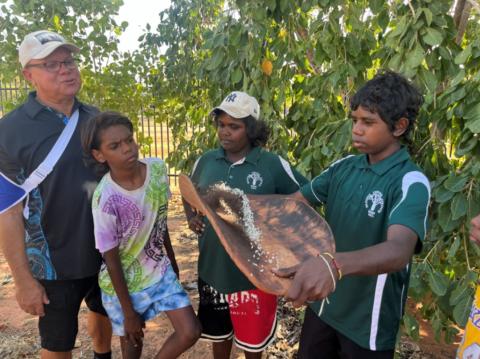
Photo courtesy of Emama Nguda Aboriginal Corporation. Students participating in cultural activities as part of the Boab Street Program.
Feedback
Feedback from a parent reported that the program transformed their family’s life, engaging all children back in school with support from older siblings. The ENAC team offered the parent employment and housing; they now work full-time and have been promoted to a supervisory role. The parent said the program improved their children’s lives, provided them with a job, and enabled them to help shape future services.
The DDHS Principal shared:
"The partnership with ENAC has addressed community challenges, engaged at-risk students, and strengthened families. Since 2023, ENAC has offered workplace learning and traineeships, starting with a small trial that has grown due to strong demand. Their expanding programs now provide diverse training opportunities, supported by dedicated mentors."