Our operating environment
We operate in a complex, uncertain and constantly evolving landscape. These challenges bring opportunities for growth and improvement. By understanding our environment, we can adopt a more strategic approach and continuously enhance our capabilities to deliver on our purpose. Our operating environment is influenced by factors that impact on our ability to deliver on our purpose. Many of these factors are out of our control.
Factors that impact our operating environment include:
» Geographical spread, population demographics and the remoteness of communities.
» Climate change and increasing natural disasters, impacting on our urban, regional and remote communities, and disaster response practices.
» The APS reform agenda to build an integrity culture, work in genuine partnership with community, become a model employer and build the capability of staff.
» Workforce trends and capability of staff to ensure we have staff with the right skills working in the right place.
» An evolving technology landscape, which provides opportunities to better connect with our staff and communities.
On this page:
- Partnerships and cooperation across governments
- Regional presence
- Integrity
- Reconciliation
- Our transformation journey
- Workforce capability
- ICT Capability
- Infrastructure capability
- Governance
Partnerships and cooperation across governments
Aboriginal and Torres Strait Islander peoples perspectives are at the centre of our planning, priority-setting and decision making. The NIAA partners with Aboriginal and Torres Strait Islander communities in a variety of ways. This includes formal policy and place-based partnership arrangements under Closing the Gap, cross-jurisdictional ECs, as well as community-specific arrangements such as the local decision-making agreements in the NT.
Each partnership has different stakeholders and objectives, and arrangements are unique, based on needs and context. Working in place and on policy or program advice requires a flexible approach that responds to the diverse needs of Aboriginal and Torres Strait Islander communities.
The NIAA's partnerships with Aboriginal and Torres Strait Islander communities are designed to support progress against Closing the Gap Priority Reform One – Formal partnerships and shared decision-making – and enable policy and place-based progress against key Closing the Gap socio-economic targets.
The NIAA and NT Government, together with Aboriginal Peak Organisations Northern Territory (APONT) have signed a partnership agreement to oversee the delivery of the $842.6 million Northern Territory Remote Aboriginal Investment (NTRAI) over 6 years, commencing 2025–26. This represents a fundamentally new way of developing and implementing policies and programs that impact the lives of Aboriginal and Torres Strait Islander peoples, including enabling opportunities for self-determination. The enduring shared decision-making arrangements set out in the partnership agreement will guide future NTRAI investment, maximising alignment to the Closing the Gap Priority Reforms during implementation, monitoring and evaluation.
The NIAA is committed to working in partnership with Aboriginal and Torres Strait Islander communities. One example is the Indigenous designed and led Empowered Communities (EC) initiative. Through the EC partnership, Aboriginal and Torres Strait Islander communities work together with government to set priorities, improve services and apply funding effectively at a regional level. It aims to give Aboriginal and Torres Strait Islander people greater influence over decisions that affect them.
The NIAA works with Aboriginal and Torres Strait Islander leaders, communities, organisations, and other stakeholders in the delivery of funded activities. In 2024–25 the Agency delivered more than 2,700 activities through some 1,300 organisations across Australia.
We continue to work closely with the Australian Public Service Commission (APSC) on the Charter of Partnerships and Engagement and the First Nations Partnership Playbook and aim to align and embed these guidelines into our practice.
All partnerships require reflection and review. The NIAA Partnership Register reviews NIAA partnerships, and the Commonwealth Partnership Stocktake reviews APS-wide partnerships with Aboriginal and Torres Strait Islander communities. Continuous improvement and strengthening of partnerships is critical to achieving tangible outcomes for Aboriginal and Torres Strait Islander communities. We continue to play a central role in informing whole-of-government priorities for Aboriginal and Torres Strait Islander peoples and in enabling policies, programs and services being tailored to the needs of communities. We do this by leveraging the strong relationships we have built with Aboriginal and Torres Strait Islander communities and through structures such as the Coalition of Peaks and ECs.
Regional presence
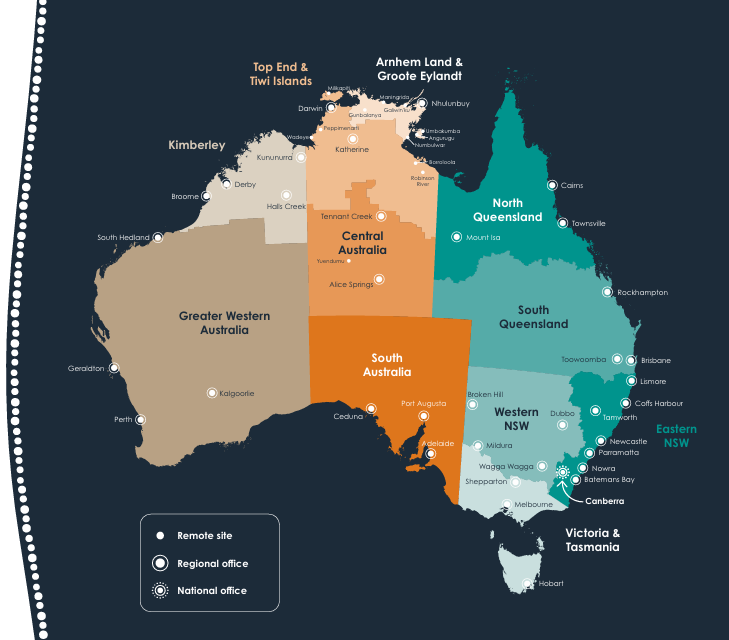 The NIAA’s regional network of offices across urban, regional and remote locations* is a unique and critical on-the-ground presence for the Australian Government. Our staff work closely with Aboriginal and Torres Strait Islander communities and stakeholders – including Aboriginal Community Controlled Organisations, non-government organisations – and across all levels of government to identify and progress Aboriginal and Torres Strait Islander peoples’ needs and aspirations.
The NIAA’s regional staff work with communities to provide practical action towards local partnership agreements, information sharing, supporting greater economic development and policy outcomes. Staff actively engage with Aboriginal and Torres Strait Islander communities and key stakeholders to play a strategic role in influencing policy and program design. Staff across the NIAA’s extensive footprint readily lean into emerging priorities including natural disaster preparedness and responses.
As NIAA builds and maintains effective partnerships with communities, organisations and peak bodies, our regional footprint contributes to the empowerment and self-determination of Aboriginal and Torres Strait Islander peoples.
*See Appendix A for NIAA office locations.
Integrity
 Integrity is the cornerstone of good governance, and is central to the effective function of the APS. Integrity supports the development and delivery of policies, services and initiatives that affect the lives of all Australians. In the APS, integrity is the pursuit of high standards of professionalism - both in what we do and how we do it.
A strong integrity culture at the NIAA supports our ability to achieve our purpose, successfully delivering our key activities, and demonstrating our commitment to ensuring that our actions and behaviours match our values, enabling a culture of trust and integrity.
The focus over the next 12 to 18 months will be:
» Consolidating and maintaining the NIAA Integrity Framework
» Implementing the NIAA Integrity Strategy and Action Plan 2025–2027
» Capability and culture building to promote a ‘speak up’ culture
» Embedding provider performance, proactive detection and early intervention processes.
Through this work, the NIAA will realise the benefits that a strong pro-integrity culture brings, and the opportunities created through building stronger relationships and fostering trust with those we serve.
Reconciliation
 Reconciliation is foundational to building a future where Aboriginal and Torres Strait Islander peoples are heard, recognised and empowered. As the Australian Government agency responsible for leading and coordinating policy, program design, and service delivery in partnership with Aboriginal and Torres Strait Islander peoples, reconciliation informs and guides our work. It shapes how we engage with Aboriginal and Torres Strait Islander peoples, communities, and organisations, and defines the leadership we provide across all aspects of our responsibilities.
The NIAA plays a key role in promoting reconciliation across the Commonwealth to ensure that reconciliation is driven across all levels of the APS, supporting work to build cultural capability including:
» The National Agreement on Closing the Gap (National Agreement) - Priority Reform Three (PR3) - Transforming Government Organisations which is emblematic of the systemic and structural transformation required to embed the principles of reconciliation that improve accountability and respond to the needs of Aboriginal and Torres Strait Islander peoples.
» The Indigenous Champions Network (ICN), bringing together leaders from across the APS who champion reconciliation by focusing on boosting PR3 outcomes are driving changes that boost Aboriginal and Torres Strait Islander employment and uplift cultural safety.
Complementary to these broader transformational reform initiatives and projects, the NIAA participates in the Reconciliation Action Plan (RAP) Framework that drives action and implementation outcomes based around the 3 core pillars of relationships, respect and opportunities.
The NIAA’s commitment to achieving our own agency focused reconciliation outcomes is realised through the strategic and sustainable actions set out under our inaugural 2022 2025 Stretch RAP and other actions being developed under our next Stretch RAP that build upon the success and lessons learned.
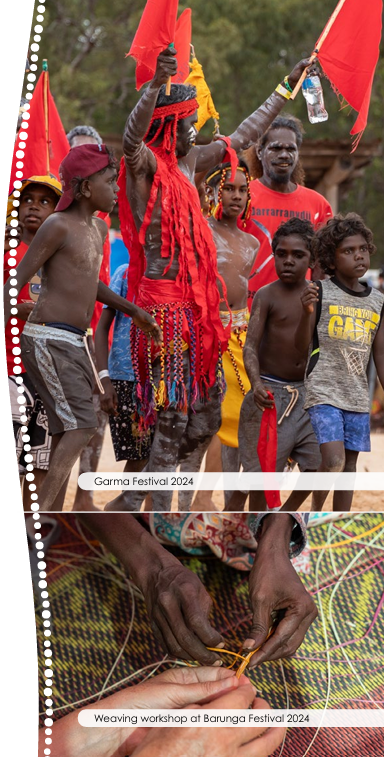
The NIAA hosts a delegation of senior leaders to Garma to promote reconciliation and further embed the Closing the Gap Priority Reforms. By fostering the Garma Alumni Network, we seek to drive outcomes and senior leadership accountability. The SES100 Program is an initiative that came from a Garma ‘fireside chat’ with senior delegates and illustrates the power of these engagements.
Our transformation journey
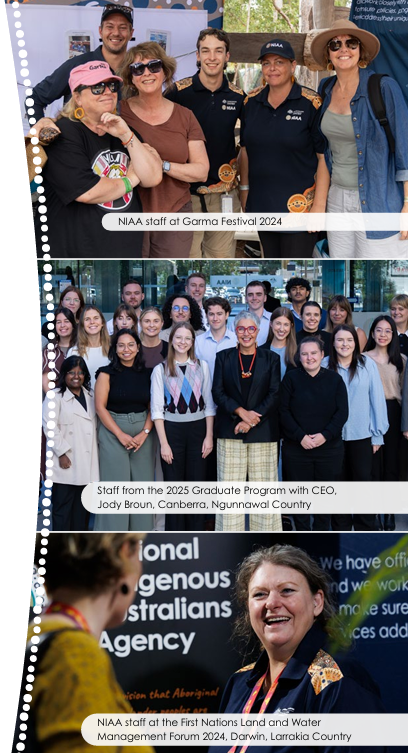 The NIAA continues to progress its transformation journey to deliver on our vision and purpose of enabling the self-determination and aspirations of Aboriginal and Torres Strait Islander communities. In line with broader APS Reforms and reflected in Galambany (a Ngunnawal word that means “you, me, we – together."), our internal transformation program, the NIAA remains committed to building staff capability. This includes embodying integrity in all that we do, being a model employer, and placing communities at the centre of our policies and services.
Having already delivered key initiatives focused on integrity, data governance and priority setting, the NIAA will continue to evolve its operations. Over the next 12 months, this transformation will come to life through a series of projects focused on delivering:
» Strengthened collaboration across government and with community to deliver Closing the Gap Priority Reforms.
» Increasing transparency of decision making, based on evidence and driven by current, accurate and reliable data.
» Prioritising investment where it can achieve maximal outcomes for community.
» Building measures of success that reflect community experience and real-world outcomes.
» Continued focus on strengthening integrity via process improvement to ensure smooth and efficient delivery, providing intended benefits.
» Upskilling staff to support them to excel in their roles, enabling better outcomes for community, the NIAA and the broader APS.
The NIAA continues to work closely with the APS Reform Office, APSC and across government to reform the way we do business.
The National Agreement on Closing the Gap Priority Reform 3 commits government organisations to systemic and structural transformation to improve accountability and respond to the needs of Aboriginal and Torres Strait Islander peoples.
Key initiatives that the NIAA will implement to drive reform and position the APS to deliver impactful outcomes, will include:
» Cultural safety uplift through programs such as the APS Integrated Unconscious Bias Training Programs. » Continuing to focus on project management capability uplift through strengthening project governance process and further refining project tools.
» Enabling systemic and structural transformation of mainstream government to improve accountability and respond to the needs of Aboriginal and Torres Strait Islander peoples, through the development of a strategy to drive Priority Reform 3 of the National Agreement on Closing the Gap.
Workforce capability
The NIAA continues to implement the APS Strategic Commissioning Framework and achieved all its targets for the 2024–25 financial year. While the NIAA has a historically low reliance on an external workforce, the NIAA continues to monitor and ensure core work is undertaken in-house, particularly in relation to administration and policy job families.
Investing in the capability of our people is an ongoing priority for the NIAA. Following the launch of NIAA’s bespoke capability framework in 2024–25, a priority of Galambany in 2025–26 is to embed the Framework to support the workforce in new ways of working. This includes tools to assist staff assess and plan their capability priorities inline with the needs of their current and future roles.
Scalable and accessible learning solutions will be offered to staff in alignment with the capability framework. The goal is a strengths-based approach to organisational and individual capability development, enabling staff to reach their career goals and full potential.
Our workforce capability priorities include strengthening data and digital skills including use of artificial intelligence, building an integrity culture including a focus on values and behaviours, and the craft of people management.
Building the cultural capability of the NIAA's workforce remains a priority. We will continue to develop this through our Footprints framework, supporting staff to participate in Jawun and other cross-cultural development opportunities.
The NIAA is committed to being an inclusive, diverse and supportive workplace, where all staff are supported to thrive. We articulate our commitment to reducing barriers to inclusion through the NIAA People Strategy 2024–27, and its supporting strategies and frameworks, including NIAA's Diversity and Inclusion Framework, Gender Equality Strategy and Census Action Plan. The NIAA also continues to be a proud member of the ‘Racism. It Stops With Me’ campaign and maintains professional memberships with Diversity Council Australia, Pride in Diversity and the Australian Disability Network to provide industry standard resources and learning opportunities.
The NIAA staff also complete activities as part of our Footprints program each year. Footprints is an award winning, cross-cultural learning and professional development framework that supports continuous and ongoing development of cross-cultural capability. It aims to ensure all staff are continually increasing and enhancing their cross-cultural capability, including developing their understanding of Aboriginal and Torres Strait Islander peoples, cultures, lands, and histories. Staff wellbeing is central to the NIAA, with staff supported through the new ‘Yarn Strong’ Program. The program targets different elements of psychological, cultural, social and emotional wellbeing, offering a variety of options for staff to opt in as it suits their preferences and needs. The program is delivered alongside other NIAA programs of work that build on NIAA’s mental health capability and targets systems, organisational culture and leadership capability to improve wellbeing at work.
The NIAA is committed to promoting a safe, inclusive and respectful workplace culture where all staff are able to work in a positive and supportive environment that is free of bullying, harassment (including sexual harassment), and discrimination.
ICT Capability
Strengthening the foundation, enabling the future
Realising the One Network vision
NIAA has successfully delivered the One Network project, marking a major milestone in our digital transformation journey. We have transitioned to a unified, cloud based network environment. This shift has significantly improved internal and external communications, strengthened our cyber security posture, and laid the groundwork for broader capability uplift. The new infrastructure is a key enabler for future innovation— supporting improved collaboration and greater operational efficiency across the NIAA.
Delivering our new ICT Strategy
Our new ICT Strategy, which aligns to Priority Reform 4, is being implemented to drive continuous improvement across our technology landscape. We are engaging with business areas to understand how technology is currently supporting operations and where it can deliver greater impact. This work is informing the development of an NIAA-wide technology roadmap, underpinned by measurable outcomes.
The strategy focuses on building a more effective and adaptive ICT function— streamlining service offerings, enhancing operational maturity, and strengthening internal capability. We are also reviewing our shared services arrangements to better leverage economies of scale. Our commitment to improving data capabilities remains strong, as we continue to embed data as a key asset in all areas of work.
Exploring emerging technologies responsibly
We are actively exploring emerging technologies, building on the foundations laid by the One Network. This includes investigating automation tools to reduce manual processes, minimise errors, support more streamlined operations, and enable staff to focus on higher-value work.
 As we enter the era of artificial intelligence (AI), the NIAA is taking a measured and responsible approach to adoption. In line with cross-government policies and frameworks, we have published our AI transparency statement. Our focus remains on using AI to support safe, effective, and efficient operations that align with our organisational goals.
We are also continuing our journey to become a data-empowered organisation, consistent with embedding Priority Reform 4 into our work. Advanced data and analytics technologies are being explored to improve insights and support informed decision-making—ensuring that data remains central to delivering positive outcomes for Aboriginal and Torres Strait Islander peoples and communities.
Infrastructure capability
The NIAA manages an extensive property portfolio across metropolitan, regional, and remote Australia to support the delivery of NIAA programs in local communities. The holdings including: 37 offices, 89 staff houses and Engagement Centres with a net value of $168 million. In the 2025–26 financial year there is approximately $3.3 million in capital funding committed to increasing capability and improving operational efficiency.
$168 million
Net value held in building, land and infrastructure.
$3.3 million
Capital upgrades to improve operational efficiency in strategic locations.
Governance
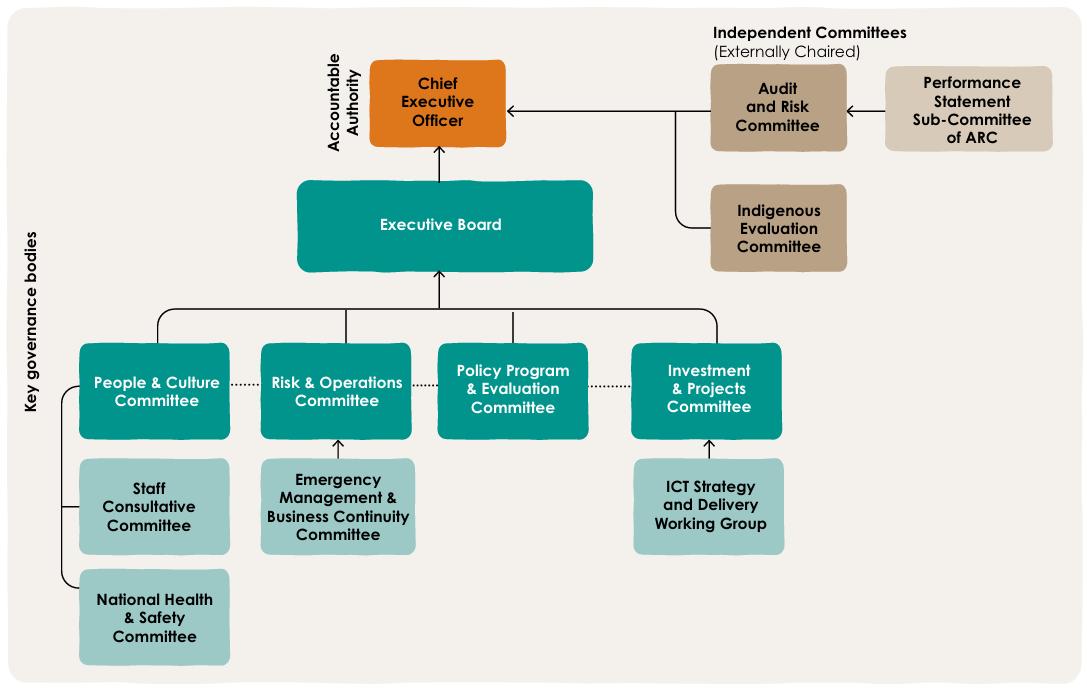
The NIAA’s governance structure and operating model supports the CEO as the NIAA Accountable Authority and ensures accountability, transparency and integrity across the organisation. In early 2025, a revised governance structure was implemented to better support robust and effective decision-making and ensure the NIAA continues to deliver on our purpose.
Structure
The Executive Board sets the strategic direction for the NIAA and is supported by 4 sub-committees:
» People and Culture Committee
» Risk and Operations Committee
» Policy, Program and Evaluation Committee
» Investment and Projects Committee.
Each sub-committee has a clearly defined scope and objectives, ensuring alignment of each sub-committee’s work program with that of the Executive Board. Where appropriate, sub committees may establish further working groups to support the achievement of their scope and objectives. The NIAA governance arrangements also includes the Indigenous Evaluation Committee that provides independent advice to the CEO and include external members.
The Indigenous Evaluation Committee supports and strengthens the quality, credibility and influence of evaluations relating to policies and programs led by the NIAA through the provision of independent strategic and technical advice.
The Audit and Risk Committee provides the CEO with independent advice on the appropriateness of NIAA’s:
» Financial reporting
» Performance reporting
» System of risk oversight and management
» Internal controls.
The Audit and Risk Committee is supported by a sub-committee established to support the NIAA’s approach to performance management and reporting.
Governance committee structure